Location: Sudbury, Ontario
Completed: 1984, 1994 (addition)
Architect: Raymond Moriyama Architects (now Moriyama Teshima Architects) with Townsend, Stefura, Baleshta and Nicholls Architects (now Bélanger Salach Architecture)
Nominated by: Jamie West, MPP (Sudbury)
A mining city in Northern Ontario might seem like an unlikely place for landmark architecture. Yet, it is precisely this unique northern context—where the boreal forest meets a global mining powerhouse—that inspired Science North, one of the province's most significant architectural landmarks.
A Deep Sense of Place
From its very inception, long before it had an architectural expression, Science North was meant to be an embodiment of its context. When reflecting on the appropriateness of a new science centre in this northern city, Canadian geophysicist, geologist, and professor Dr. John Tuzo Wilson, then director of the Ontario Science Centre, stated: “a natural location, a place where the earth's geology had baffled geologists, where advances in technology allowed the drawing out of our natural resources, and where science was helping a once-bleak landscape to become healthy again as researchers pioneer regreening studies.” Funding for the initial studies—and later on for construction—would also be tied to its place: mining giants Inco Ltd. and Falconbridge Ltd. providing critical financial backing.
When design work finally started in the 1980s, this deep connection to place would be the guiding principle for the science centre. Toronto Architect Raymond Moriyama, who had designed the award-winning Ontario Science Centre, and local Architect John Stefura proposed a six-sided building set both inside and above a rocky outcropping at Bell Grove. The design is described as “a snowflake settling gently over a rugged crater”—the snowflake a symbol of the glaciation and climate that had shaped the northern landscape, the rock speaking to the Sudbury Basin, the mineral-rich impact crater on which the city was built.
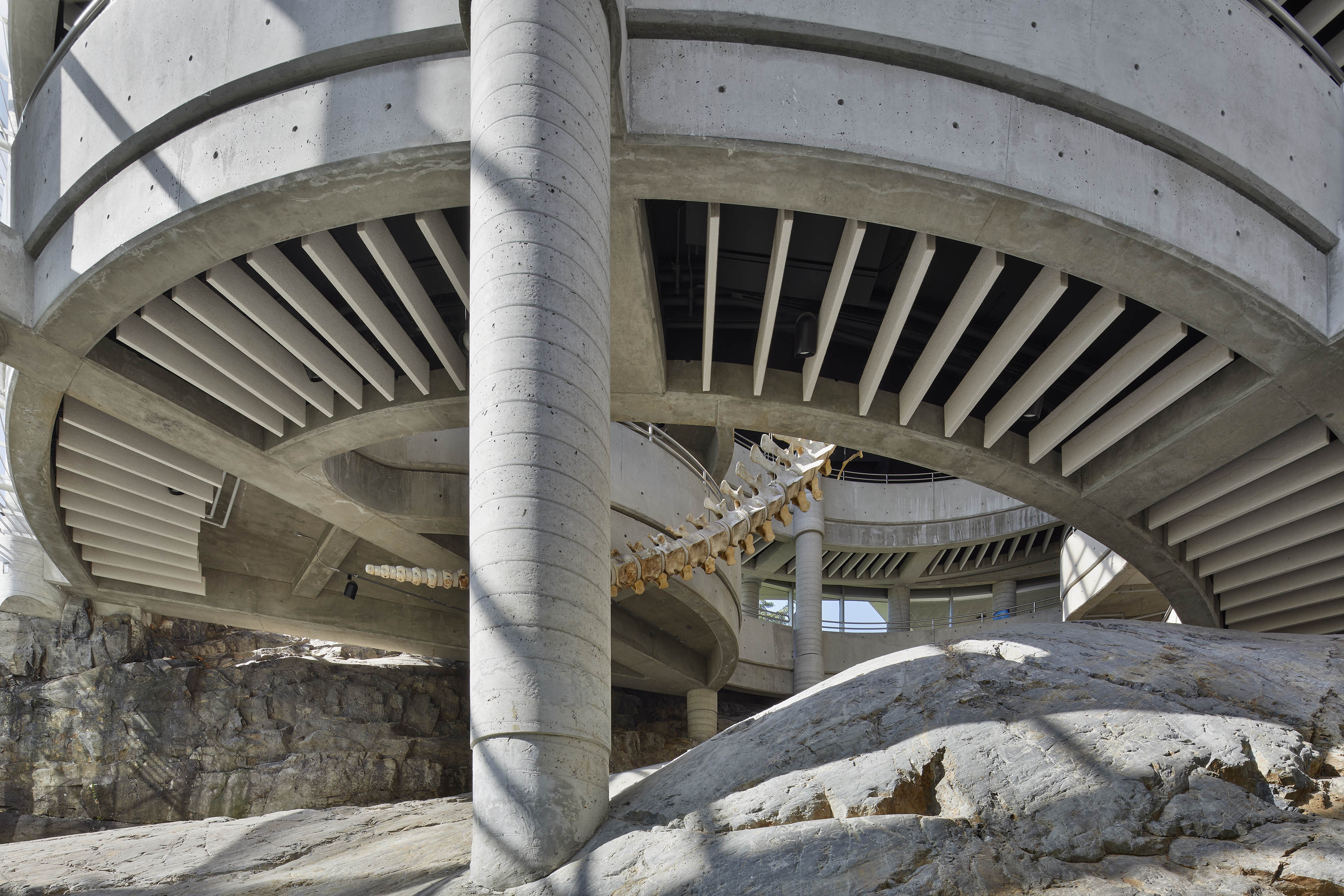
Image: The Bélanger-Salach Architecture Ramp at Science North, showing the building’s concrete structure meeting the rocky Canadian Shield below. Image by Tom Arban, courtesy of Bélanger-Salach Architecture.
The experience of visiting the centre further underlines Sudbury’s unique geological history with visitors entering through a mined tunnel and the centre’s main building built directly over the Creighton Fault, an ancient geological fault line made visible through exposed rock. Outside, the glistening facade of the snowflake is clad in stainless steel panels, a material that uses nickel—the most common and famous metal mined in the region.
This reflection of place is carried through into the science centre’s curation. For example, the ecosystem exhibit focuses on the boreal forest, and all content is strictly curated to serve the region’s bilingual Franco-Ontarian population. Conscious of its location on the traditional lands of the Atikameksheng Anishnawbek and Wahnapitae First Nation, the centre works with Indigenous Knowledge Keepers to blend Western science with land-based Traditional Ecological Knowledge, highlighting Indigenous star mapping, navigation, and storytelling.
Hands-On Learning
While clearly distinct from its southern counterpart, an aspect shared by both the Ontario Science Centre and Science North was a commitment to hands-on education. In fact, it would be the Ontario Science Centre that would pioneer this novel method of learning and set a precedent for science centres throughout the world.
In the case of Science North, this interactive nature was particularly critical due to its relative geographic isolation. While other centres might rely on a stream of new visitors coming in every day, Sudbury’s location meant it would need frequent returning users. Traditional push-button exhibits, with a simple cause-and-effect interaction, would be insufficient to keep their interest long-term and constant redesign of exhibits would be a significant expense. The answer was to design exhibits and experiences that were interactive and open-ended, where ordinary people would take part in active processes that made science evident. To facilitate this way of learning, Science North developed the “Bluecoats Program,” science staff and volunteers who share their knowledge and tailor the experience to every visitor. Whether it is a simple explanation of a scientific principle, or an in-depth experiment that allows you to experience a phenomena, the Bluecoats can individualize the experience and make each visit unique.
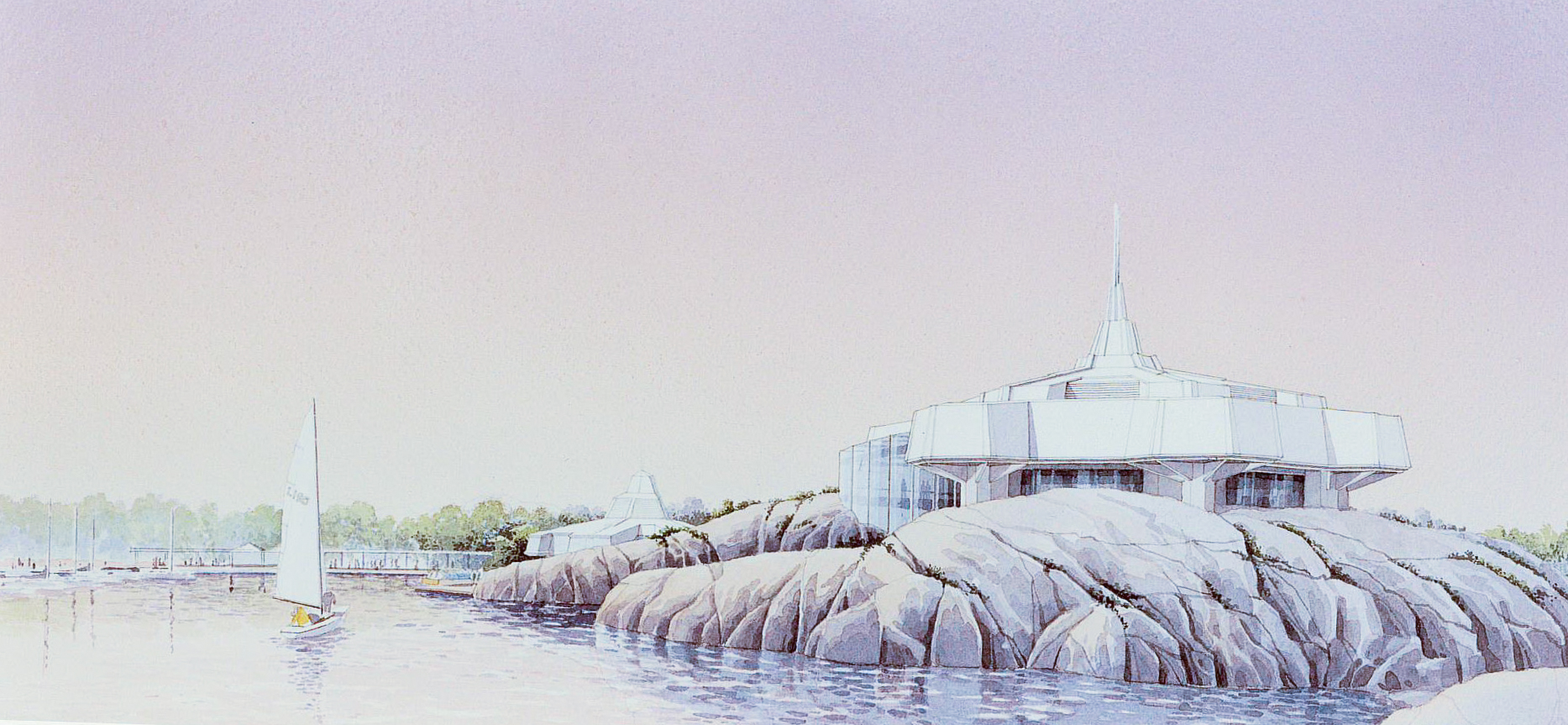
Image: Drawing of Science North as seen from the northwest. Image courtesy of Bélanger Salach Architecture.
A Footprint Beyond its Site
The success of Science North has led to a footprint far beyond its site. Looking to expand science education, Science North opened Dynamic Earth in 2003, designed by Yallowega Bélanger Architects (now Bélanger Salach Architecture), an interactive earth sciences museum built from an existing 1960s mock demonstration mine fully owned and operated by the science centre. The science centre also runs an outreach program, bringing science education to communities all across Northern Ontario, including places like Kenora, Thunder Bay, Sioux Narrows, Atikokan, North Bay, and Parry Sound. This outreach has been so effective that plans have started for a permanent branch location in Thunder Bay, with initial designs done by Moriyama Teshima Architects. These designs, though quite early, reflect a similar thoughtfulness and sense of place as the Sudbury location.
More than 40 years after its opening, Science North continues to redefine what a regional science centre can achieve. From its Sudbury roots to its expanding presence across the boreal north, it stands as a masterclass in contextual architecture—showing that when a building truly belongs to its landscape, its story never gets old.
This post is part of the OAA’s Queen’s Park Picks 2026 series, where Ontario’s Members of Provincial Parliament (MPPs) were encouraged to nominate a building in their riding for a chance to learn more about it. This year, MPPs were asked to consider various typologies related to "collaboration powering innovation” when making their suggestion, tying into the 2026 OAA Conference theme. Check out the rest of the series to learn more about great buildings across the province.